Cards · B5 · Instrument Slot A
B5 Dynamic signal analyzer
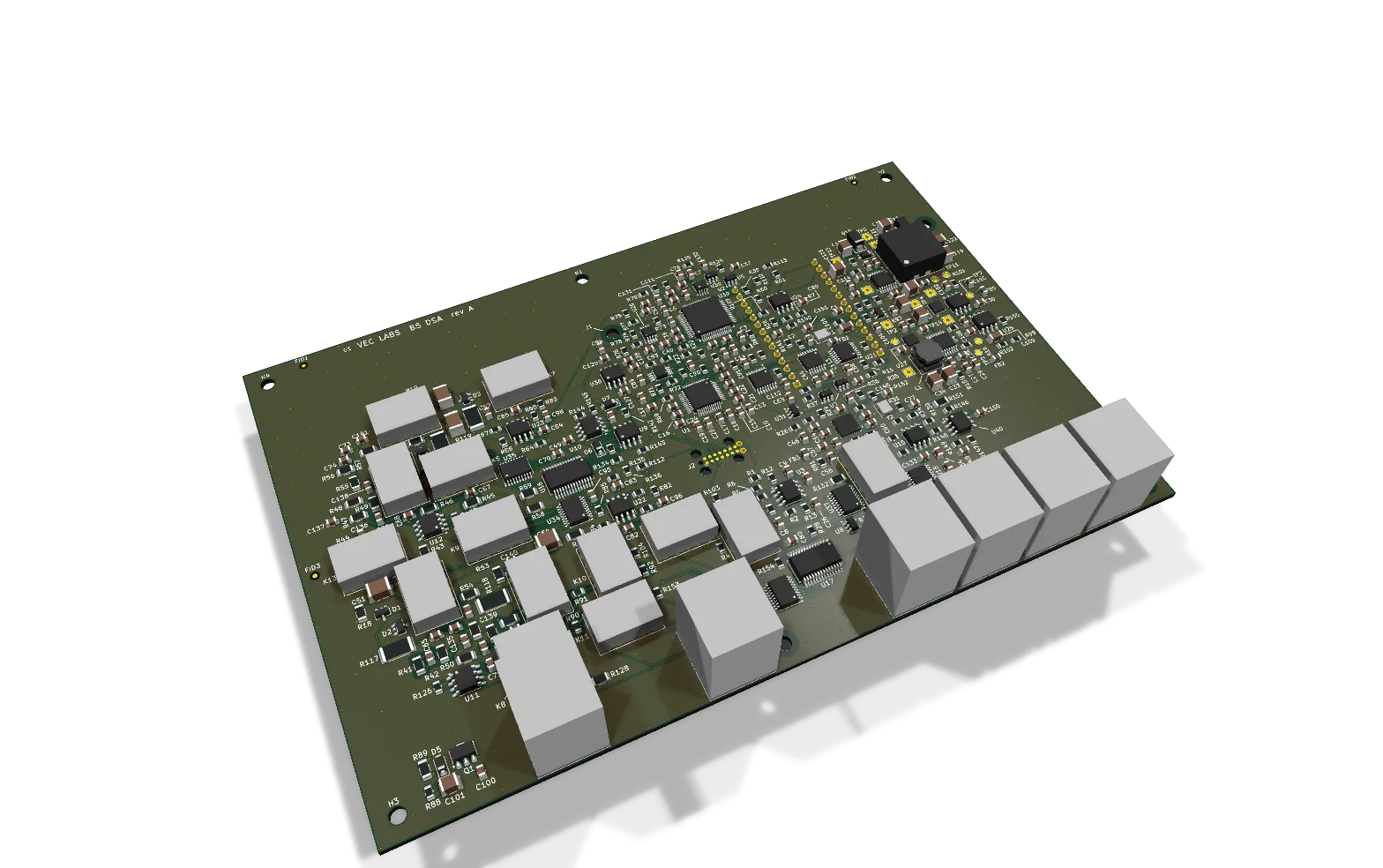
Two 24-bit channels and sources of its own: a spectrum analyzer and an audio-band network analyzer in one card.
In design
What it is
B5 measures everything in the audio band that's a spectrum, a ratio of spectra or a distortion figure: audio gear, loudspeakers, a machine's vibration, an accelerometer on a structure.
With its own source, it's a vector network analyzer for the audio band. Drive a device from the card, put one input on the device's input and the other on its output, and B5 gives you gain and phase at every frequency. A chirp or a multitone excites every frequency at once, so it takes one record, not a sweep. The source and the sampler run from one clock, so the question and the answer line up exactly. The two inputs are sampled at the same instant, so the phase is real.
It also powers IEPE accelerometers and microphones directly. Drive a shaker from the source through its amplifier, put an accelerometer on the structure, and you're doing modal analysis on one card.
Capabilities
Design values. Measured values replace these after bring-up.
- Two channels, sampled simultaneously at 256,000 samples a second, DC to 110.8 kHz.
- 24-bit, with four input ranges from 290 mV to 290 V RMS.
- Transfer functions in magnitude, phase and group delay, with coherence showing where the answer is trustworthy.
- Two sources on one output. A synthesizer (sine, arbitrary, multitone, chirp, noise, sawtooth, DC) to ±4.98 V peak for transfer functions, and an audio-grade DAC to ±11.2 V peak for a purer tone for distortion work (both nominal).
- The sources are yours. Use them on their own as a function generator, and a second, wideband output carries it well above the audio band.
- IEPE excitation (4 mA) on each input.
- BNC connectors. A larger card; Instrument Slot A only.
Build with it
- A filter's Bode plot. A chirp from 20 Hz to 100 kHz, one input on each side of the filter: magnitude, phase and group delay from one measurement.
- An amplifier's distortion. The audio DAC drives it; B5 reads its harmonics.
- A loudspeaker's response. The source through an amplifier into the speaker, the amplifier's output on one input and a measurement microphone on the other: frequency response and impulse response.
- Modal analysis. The source drives a shaker through its amplifier; an IEPE accelerometer reads the structure.
- CNC spindle. Listen to the spindle's vibration while A7 runs the drive.
Calibration
B5's factory anchor is two standards and a clock. How calibration works