Cards · B4 · Instrument Slot B
B4 Lock-in amplifier
A lock-in amplifier that drives its own experiment and pulls the answer out from under the noise.
In design
What it is
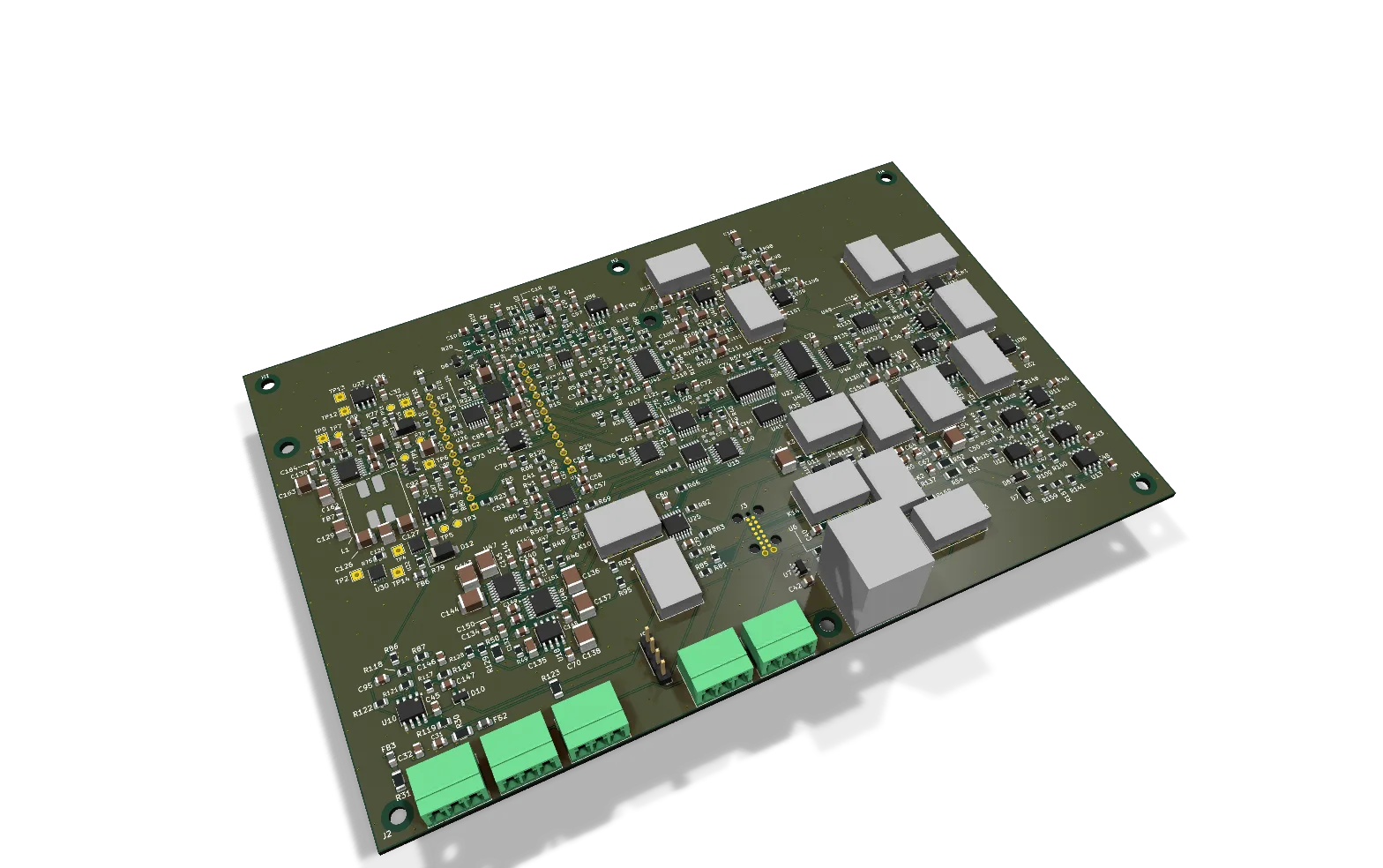
B4 is a lock-in amplifier on a card. Modulate anything (an LED, a heater, a bridge's excitation) and B4 recovers the response at exactly that frequency, far below the noise around it.
It makes the modulation too. B4 carries its own excitation source, clocked from the same oscillator as its converter, so the drive and the measurement can't drift apart. There's no chopper wheel and no reference cable: wire an LED to the excitation output and a photodiode to the current input, and B4 picks that LED out across a lit room. On a scope, the LED is lost in the room light.
Capabilities
Design values. Measured values replace these after bring-up.
- Reference from 0.16 Hz to 250 kHz.
- An excitation output of ±7.2 V open circuit (nominal): sine, arbitrary, multitone, chirp, noise, sawtooth or DC. The card measures the excitation it actually delivers, so readings are ratios to the real drive.
- The excitation is yours. Use it on its own as a function generator, to about 0.5 MHz.
- Multitone excitation, demodulated at every tone at once: an impedance spectrum in one dwell instead of a sweep.
- A reference input for when the experiment owns the clock: a chopper wheel's pickup, another instrument's sync, the mains.
- Voltage input ranges from 227 µV to 11 V, and a current input from about 23 nA to 11.5 µA.
- A 16-bit converter at 1.024 million samples a second.
- A bipolar or a JFET input amplifier, for low- or high-impedance sources.
- A larger card that grows outboard of its slot; Instrument Slot B only.
Build with it
- An LED across a lit room. An LED, a photodiode and B4. Nothing else.
- 3ω thermal conductivity. Heat a metal line at one frequency from the excitation output and read the small signal its heating leaves at three times that frequency. The detection is numerical, so it needs no extra hardware. A C4 calibrates the line.
- Electrochemical impedance and AC bridges. Drive the cell or the bridge from the card, add a series resistor, and read impedance in magnitude and phase.
- AC four-wire resistance below a milliohm, free of the thermal EMFs that spoil a DC reading.
Calibration
B4's factory anchor is a resistor and a clock, not a meter, and it calibrates its own signal path by injection. How calibration works